70% of Photoshop Editors Will Be Replaced by AI — Here’s Who Will Survive
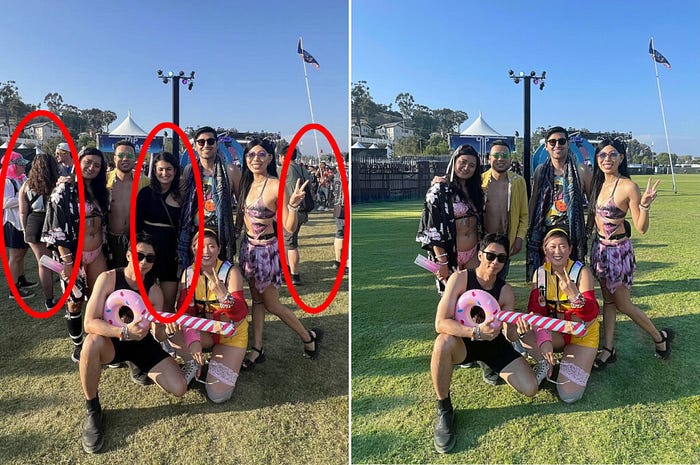
The conversation used to be hypothetical. Now it’s not. AI tools are doing in seconds what a skilled Photoshop Editor used to spend hours on. Background removal, object cleanup, color correction, even complex masking. Clients are noticing. And some of them are starting to wonder if they still need to hire a human at all. The honest answer is: it depends on what that human actually brings to the table.
This isn’t a doom piece. It’s a realistic look at where things are heading, what AI still can’t do well, and why the editors who understand the difference will not only survive but end up doing better work for better clients.
How to Remove People from Group Photos: What AI Gets Right and Gets Wrong
AI tools have gotten genuinely impressive at basic object removal from photos. Ask a modern AI app to remove a stranger who walked into the corner of your travel shot, and it’ll handle it reasonably well. The background fills in, the edges look clean, and the whole thing takes about ten seconds.
But here’s what most people don’t talk about. AI struggles the moment the scene gets complicated. A task like removing background people from photos naturally becomes a real problem when those people are overlapping with your subject, casting shadows across the frame, or standing in front of complex architectural details. The AI guesses. Sometimes it guesses well. Often it doesn’t.
Knowing how to remove people from group photos in Photoshop properly, using content aware fill, the clone stamp tool, and careful layer masking, still requires human judgment. Which part of the background do you reconstruct? How do you match the grain and texture so the edit is invisible? AI doesn’t think about that. It just fills. And experienced clients can tell the difference immediately.
Remove Unwanted Person from Photo: Where Human Editors Still Win
There’s a class of editing work where human skill isn’t optional. Think about a wedding photographer who needs to remove an unwanted person from a photo that also contains the couple in close proximity. Or a commercial real estate shoot where removing background people from the lobby without disturbing the lighting reflections on marble floors is the whole job.
These aren’t edge cases. They come up constantly in professional work. And the best way to remove someone from a picture in these situations involves photo manipulation techniques in Photoshop that take years to get right. Frequency separation, luminosity masking, advanced patch work. None of that is automated yet in any meaningful way.
The editors who’ve built those skills are genuinely hard to replace. The ones who’ve been doing basic cutouts and simple background correction with minimal technique? They’re already being displaced, and that’s only going to accelerate.

Photoshop Service: The Human Layer AI Can’t Replicate
There’s something that doesn’t show up in tutorials or tool comparisons. It’s the part of professional editing that’s actually about understanding what the client needs, sometimes before the client knows how to articulate it.
A strong Photoshop Service isn’t just technical execution. It’s communication, context, and creative problem-solving. When a brand sends over 200 product images for an eCommerce photo editing service USA campaign, they’re not just paying for the edits. They’re paying for consistency, accuracy, and someone who understands their visual identity well enough to apply judgment call after judgment call without being micromanaged.
AI can process batches. It can’t build relationships. It can’t tell you when an edit is technically correct but creatively wrong for the brand. That kind of editorial sense is what the best editors carry, and it’s not teachable by algorithm.
If you’re a business looking to hire a Photoshop editor online or outsource photo editing services USA, the question to ask isn’t just “can this tool or person remove a person from a photo.” It’s “do they understand what this image needs to do for my business.” The answer to that question still points toward humans, specifically experienced ones.
How to Edit Group Photos Professionally in an AI World
Photographers and editors working with group shots are dealing with a specific set of recurring challenges. Someone always blinks. Someone always drifts to the edge of the frame. Corporate headshots need consistency across a team shot on different days. Family portraits need a version where everyone looks good, which might mean compositing two or three frames together.
Learning how to edit group photos professionally means knowing how to do all of this cleanly. It means understanding perspective so that a swapped head sits correctly on the body. It means matching skin tones across different light conditions. It means removing strangers from travel photos without leaving a ghost of where they stood.
AI tools are getting better at the easier versions of these tasks. But the professional standard is still set by human editors who know what “looks real” actually means and have trained their eye to catch the things that don’t.
The photo editing service at Pro Photoshop Expert handles exactly this kind of work, complex group photo cleanup, background correction, and image retouching done at a quality level that automated tools consistently fall short of.

Fix Group Photo Results with Advanced Retouching Methods
The editors who thrive in an AI-heavy market are the ones positioning themselves as specialists. Not general retouchers. Specialists in advanced photo retouching methods that require deep Photoshop knowledge.
The clone stamp tool Photoshop guide knowledge that took years to develop. The content aware fill Photoshop techniques that still need a trained eye to direct correctly. Photo enhancement service work that involves color science, not just presets. These skills compound over time in a way that AI adoption actually rewards, because the gap between “AI output” and “polished professional result” becomes your value proposition.
If you’re offering an affordable clipping path service alongside high-end retouching, you’ve got a full-service offer that covers both the volume eCommerce side and the premium editorial side. That’s a smart position to be in right now.

Professional Photo Editing Service USA: What Clients Are Actually Looking For
US clients, especially eCommerce brands and commercial photographers, are not just looking for the cheapest option. They’re looking for reliability. Turnaround time. Quality they don’t have to double-check every time.
The remove people from photo service requests that come from US businesses are often tied to real deadlines. A product launch. A campaign going live Monday. A listing that needs to be up before the weekend. In those situations, a Photoshop expert for hire USA who delivers consistently is worth significantly more than an AI tool that delivers inconsistently.
That’s the real pitch for human editors right now. Not that AI is bad. It’s that consistency, context, and client trust are still human advantages. The editors who understand this, and who market themselves accordingly, are the ones who’ll still be busy three years from now.
You can see what a professional editing operation looks like when you visit prophotoshopexpert.com. The range of services, the quality benchmarks, the turnaround expectations. It’s what clients are actually buying when they stop shopping on price alone.
The Editors Who Survive Will Think Differently
AI won’t kill photo editing. It’ll kill the version of photo editing that was always just mechanical repetition with no real skill underneath.
The editors who survive are going to be the ones who treat digital image editing as a craft, not a task. They’ll know when to use AI tools to speed up their process and when to ignore them entirely. They’ll have opinions. They’ll have specializations. And they’ll have client relationships built on trust that no tool can automate away.
That 70% figure in the headline? It’s not a scare tactic. It’s a rough read on how many editors are currently doing work that AI can already replicate well enough. The other 30% are building something different. You can still choose which group you’re in.


Comments
Post a Comment